
This is Us! Chit chat series with Marc and Carolyn on The Good Gang

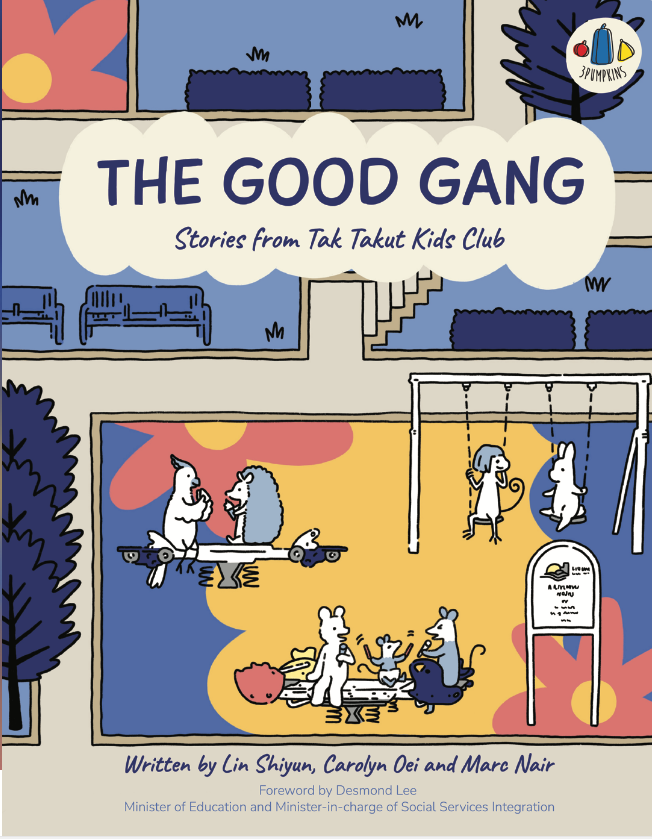
Marc Nair and Carolyn Oei are two of the three authors behind The Good Gang, a book that documents the work of TTKC. The book brings together ten stories centred on the lived realities of children navigating complex systems — schools, social services, families, and institutions that often fail to see them fully.
The idea for The Good Gang began with Shiyun, founder and executive director of 3Pumpkins, who had long wanted to document the first five years of TTKC. At some point, the word "book" surfaced between the three of them — and once it did, the conversations didn't really stop.
In this conversation, we speak with Marc and Carolyn about how the book came to be, the stories that stayed with them, and what it means to be part of "The Good Gang."
About the Authors
Marc Nair is a poet, photographer, educator and performance auto-ethnographer whose career has spanned over two decades exploring ethnicity, identity and the everyday. He has taught English, Literature and creative writing at the high school, undergraduate and IB levels, represented Singapore at international slam competitions, and published 12 collections of poetry. His latest photo poetry collection is Undulations (2025, Delere Press).
Carolyn Oei is an artist, educator and writer with a background in law, public relations and communications. She has authored four non-fiction titles and her essays have appeared in Mekong Review, Jom and Asian Geographic. She is currently pursuing doctoral studies at the Ontario Institute for Studies in Education (OISE), University of Toronto, where her research sits at the nexus of community development, participatory culture and environmental justice.

How did each of you first get involved with TTKC?
Carolyn: I was doing my Master's of Education at NIE in 2020, and my lecturer Noorlinah told me about Shiyun and 3Pumpkins. I was taking a course called Theatre in the Community, which is essentially community art with a social change element. When I contacted Shiyun on Facebook, she said, "If you want to do research, you have to come and volunteer first." I thought that was fair.
My first visit was on a Saturday afternoon. They were filming for a fundraiser, though no one seemed entirely sure what was going on. Shiyun was holding some Play-Doh, kids were running around, and conversations kept getting interrupted. And she just told me to hang out. I didn't really know what to do with myself. I've volunteered with animals before, and I learned to make yourself small, invisible, and let them come to you. So I just sat there. Then this little boy walked up, put something under my nose, and asked, "Is this Blu-Tack?" I said yes — and that was it, that was the start.
Marc: I wasn't there to volunteer at first — I came in through special projects. The arrangement was that I'd take photographs, and in return, I could be in the space. I was working on a photo essay, so I visited a few times to observe different activities and how TTKC held space.
Later, I made a documentary for them, which involved interviews, scripting, everything. I'm quite outcome-oriented — I think in projects. But through those projects, you also learn a lot. TTKC is the kind of place where, if there's a need, you try to fill it. If they ask you, it's because they really need help.
How did you arrive at the title The Good Gang?
Marc: There were so many iterations for the title. We were trying to be really fancy — deep and cheeky. Then we saw "The Good Gang" on the TTKC website. I think it was a quote from Shiyun. It just popped out. We realised: it's already there. Let's use it. I liked the tension in the word "gang."
Carolyn: Because it's usually figured negatively.
Marc: Exactly. But when you put "The Good Gang" together, it changes the texture of the word. It becomes about togetherness rather than rebellion.
Carolyn: Or a reclamation of it. Also, Boon Lay has a lot of gangs operating — that's the reality. So the tension is that we're the alternative gang. We're The Good Gang.
Structuring the Stories
How did you decide to frame each story?
Carolyn: It's child-centric, so the child is always at the centre of each story. If you think about Bronfenbrenner's ecological model, that's really how each story is structured. But it's not always neatly concentric — sometimes it moves from a smaller circle to a larger one, then back again. Each story is calibrated differently, because each child's needs are different.

Including the actual dialogue from the interviews was one way we ensured their voices were really captured. You get a sense of who they were, unfiltered. That helped locate the child within this morass of competing influences. It was really important to centre them, and keep them centred.
The explanatory boxes about the different agencies came about later, because we realised how many of these systems were involved. By highlighting them, we point to the multiple stakeholders in each child's life. Some stories are more top-heavy with these because that child crosses many different lines. The reader realises: Oh, this is complex. It's not just one agency. It's not just a child behaving in a certain way. It's never that simple.

Excerpt from Adam and Amos’s story, with explanatory boxes highlighting different agencies.
Marc: If it had been written purely from the child's POV, it would have been limited. What we wanted to show were the actual gaping holes — the cracks that these kids were falling through.
The only way to do that was to write from a kind of objective third-person view, where we're still telling their stories and centring the child, which is why the dialogue was so important. That's also why there isn't a strong narratorial voice in the stories. The narration is quite neutral. But when the dialogue comes in, it hits the reader. It can't be neutral, because you're dealing with someone who has all these complex issues to live with. Put together, the ten stories deal with very different issues, which also shows the breadth of the work that TTKC does.
Each child in the book is depicted as an illustrated animal. How did that come about, and how did you choose which animal fit each child?
Carolyn: The primary reason was privacy — we couldn't have any visual identifiers of the children. But the whole ethos of TTKC and The Good Gang is about amplifying the children's voices and seeing them as full people. We couldn't just leave them completely anonymous. Animals felt right because they're so much a part of how we understand the world. So much of what we learn comes from the animal kingdom.
Marc: We really enjoyed looking for animals that captured something essential about each child. Riley is a hedgehog — she's wary of people getting too close. Batrisya is a chameleon, always trying to fit into different environments. Caleb is a peacock because he has a big personality and always makes his presence known.
Across all the stories, what recurring patterns did you notice — especially about what the system doesn't hear or can't hold?
Marc: The recurring pattern we saw — and something we also experience firsthand as volunteers — is that most of the children at TTKC come from disadvantaged backgrounds. But what does disadvantaged even mean? There are so many different levels and extents of disadvantage.
Carolyn: Mental health issues, single-parent families, domestic abuse, parents who are incarcerated, learning disabilities, sheer neglect — and also just bad luck. The primary pattern was that the children were all hard done by. And hard done by whom? By adults. By the system — by schools, by parents, by social service workers. Sometimes their views weren't taken into account, like in Batrisya's story, where the social worker was there for the mother, but not for Batrisya. Sometimes children were overlooked because caregivers presented things as stable, like in Adam and Amos's cases.
What this shows is that TTKC becomes the space where all these issues surface — precisely because children are given room to just be. It's not that TTKC is responsible for these problems, but it has become a kind of proxy space for them. Probably unintentionally.
Marc: Unintentionally, yeah. All these things emerge, and then they become serious enough that you can't look away.
Carolyn: Exactly. That's why Shiyun couldn't look away, even back in 2016 when she started Let's Go Play Outdoors. It was through that programme that she realised there were so many children who had never been to a museum — or even to the beach.
Marc: Naturally, she couldn't stop there. But it's not her responsibility alone. It's society's responsibility. These issues are too complex and too widespread to point to a single actor.
Do either of you have stories that are particularly sticky with you — that stay with you?
Carolyn: Colin. His issues are almost invisible. He is so unseen. It's like the worst thing — he just exists. The neglect… it's heartbreaking to see how a child's development can be so severely stunted by a lack of attention. That story continues to move me the most. Maybe because I feel the most helpless when it comes to a child like Colin. With cases of physical abuse or violence, you feel like you can do something — take the child out of that dangerous environment. But what do you do about Colin? How do you step in to help? The school system couldn't help him. It continues not to be able to help him. The welfare system is also dicey, as far as his mother's care is concerned. And in the meantime, he just rides a possibly stolen bicycle around the estate and doesn't really make much sense when you talk to him.
Excerpts from Colin's Story
Marc: For me, it would be Simon. The way the story opens — with Simon doing lion dance — came from a time when we went down to observe them training at Boon Lay Shopping Centre. Looking at the surroundings, seeing how Simon and the other boys were so keen, so invested. They seemed like fish out of water, but also like they were trying to find an identity for themselves. What's frustrating about Simon's story is that his attempts at that keep getting thwarted. Sometimes by his own recklessness, his own choices — but those choices are also driven by things that are out of his control.
Carolyn: He's only a child.
Marc: Yeah. There's a kind of helplessness there. And then he acts out because of that. And the story continues. I think for all of them, there's no clean ending. It's more like: TTKC will continue to be here. And if the child wants to keep showing up, they'll keep showing up. We'll do what we can. It's not a happy ending. It's not a resolute ending. But I guess that's the reality.
What changes need to happen? Who needs to listen, and how do these changes happen?
Marc: As writers and researchers, what we've done is shine a light on these issues. And that makes some people uncomfortable — because it's like, "Oh, okay, that's our agency not doing so well."
I think of it like this: Singapore is a big, shiny house. And we're pointing out, "Actually, this beam has cracked. There are cockroaches in the cupboard." And the response is often, "No, no, no — it's a shiny house." So everything gets swept into a corner. That reflects a larger national narrative: progress equals growth equals wealth equals happiness. That's the meritocratic story, the ship that's always climbing. So failure doesn't really exist. It's just success after success after success. This way of thinking is bigger than just saying it's the government's fault. It's all of society.
How can people be part of The Good Gang?
Carolyn: We've lost community in Singapore. We've lost the understanding of how to do community — how to be community. There's so much reliance on someone else doing it for us. People don't even talk to one another anymore because it's so easy to call the police. Anything, just call. Conversation, even participation, becomes confrontation.
To do community, you need space. You need physical space. In Singapore, that's such a prized commodity. If you think about void decks in HDB blocks, those were meant to be places where community gathered. But there are so many things you can't do in a void deck.
How do people build community? That's what TTKC does. It's one of the very few spaces in Singapore that's messy, chaotic, and open. People can come as they are. Even if you're uncomfortable at first because you don't know what to do, that makes sense. You're an outsider to the community. It takes time to get through that friction, that discomfort of getting to know one another, finding out how different you are, and still learning how to have fun together.
What do you hope readers take away?
Marc: That this is Singapore. This is also Singapore. In addition to Marina Bay Sands and F1 — this is a true manifestation of wealth inequality and social inequality. If you want to talk about cracks in the system, this is it. These aren't exceptional stories. These are just the everyday realities of people who live here.
Carolyn: Absolutely. It's so ordinary that people don't even know these lives exist.
The Good Gang is available for order here.
Come read it with us — book club discussion in July, find out more here.


Comments